
History of PAP (Part IV) – Lim Chin Siong
The Man Who Almost Became Prime Minister
“Chin Siong was introduced to me by Lee Kuan Yew. Kuan Yew came to visit me in my little office underneath the stairs and said, “Meet the future Prime Minister of Singapore!” I looked at Lim Chin Siong and I laughed. LKY said, “Don’t laugh!” He is the finest Chinese orator in Singapore and he will be our next Prime Minister!” - David Marshall
Lim Chin Siong is an elusive figure in Singapore’s history. He was a charismatic catalyst to the mass movements of the 1950s and early 1960s, and his political personality helped define an era. To Lee Kuan Yew, Lim Chin Siong was probably his greatest adversary that he respected. Lim did what LKY could not do in the 1950s: mobilize tens of thousands ethnic Chinese just by his words. Lim Chin Siong, was not recognized but is one the founding members of the PAP. His very presence in our history shaped not only our independence but also how the concept of detention without trail (by ISD) and the affiliation of the labour union (eg: NTUC) to the PAP.
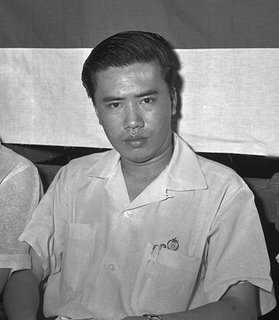 Time and time again, I’ve mentioned that history is often written by victors, victors of a political dogfight and victors of unfair competition. The winners will get titles that remain across time encapsulating their distinguished successes but not their failures. The losers sometime suffer a fate worse than death, which is that their name being erased of annals. Simply, their lives and their accomplishments never existed. If one mentioned about Dr Goh Keng Swee, the title of “the architect of Singapore’s economic success” comes to mind. Similar, Lee Kuan Yew, the “founder of Modern Singapore”. But if one mentioned about Lim Chin Siong, it might be a slate of blank. At most, he is remembered as the “Communist” or the “vanquished” (mentioned in Lee’s Lieutenants). Personally, I would favour the title “the Man Who Almost Became Prime Minister” for Lim. For this article, I’ll be drawing information from “Comet in our Sky – Lim Chin Siong n History” by Tan Jing Quee (published by INSAN press Kuala Lumpur) and Melanie Chew’s interview with Lim Chin Siong himself.
The Making of the Hokkien Hero
Lim Chin Siong was born in Telok Ayer in the Hokkien heartland of Singapore’s Chinatown in 28 February 1933. Life was harsh in his early years, and had to stop school during the Japanese Occupation when he was around 9 years old. It was during this hardship that shaped his political inclinations and to be supportive to radical anti-colonial causes mashed with Chinese Nationalism.
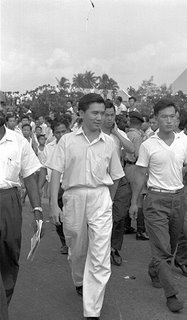 When the war ended, Chin Siong returned to school at Pei Chun and completed his primary school education; he had lost three years and was considerably older than he would have been if not for the war. The Malayan Communist Party (MCP) had emerged from the war as an ally of the British in the prosecution of the anti-Japanese was and was accorded honours and lawful status in the political life of the country. However, in 1948, MCP’s relations deteriorated to breaking point; widespread labour demonstrations and strikes, arrested and political organization bans led to retaliation, murders and open declaration of war. The MCP was outlawed and took to the jungle to wage an armed guerilla struggle.
In 1949, Chin Siong enrolled into Catholic High School. He soon found school life there restrictive and transferred himself to Chinese High School. He was now sixteen years old and began to show interest in Chinese patriotism, national salvation and social justice, leading him to read writers like Lu Xun and Lao She. He would soon make his mark as an active student leader, espouse radical causes, and become firm friends with Fong Swee Suan, his classmate in Chinese High School.
Baptism of Politics
In 1951, they were in Junior Middle III and required to sit for an external examination, before graduating or advancing to Senior Middle School. This common external examination was a throwback to the pre-1949 Kuomintang era and precondition for access to further education in China. With the China Revolution in 1949, admission to higher education was closed in Mainland China. Hence, the retention and continuance of such common examination was an attempt by the British to limit further education to the Chinese left-wing students.
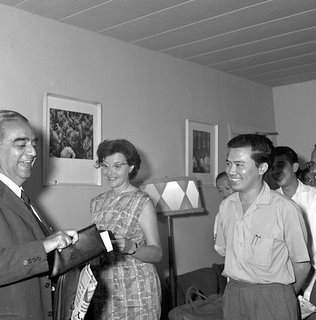 Chin Siong and Fong organized a body called, “Students Opposing The Junior Middle III Examinations, galvanizing support for boycotting the examinations. They wrote pamplets, made speeches condemning colonialism and advocated fair and equal treatment for Chinese schools and students. It was in these years, Chin Siong joined the Anti-British League (ABL). These activities eventually caught the attention of the Special Branch (British version of ISD). Chin Siong was detained for a week in August 1951 and again in October 1951 over the examination boycott. He was released, but was expelled from school, together with more than eighty students in the class of 1951.
Singapore Factory and Shop Workers Union
In 1954, an innocuous event would transform and catapult Chin Siong into greater prominence. He was elected Secretary of a small union bearing the grandiose name of Singapore Factory and Shop Workers Union (SFSWU) with a membership of barely 300 members. Within a brief period of just a year, the membership of SFSWU had expanded rapidly to more than 30,000, making it one of the most powerful trade unions in Singapore at that time.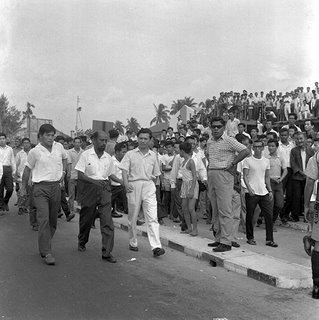
Chin Siong would be prominent enough to attract the attention of Lee Kuan Yew and colleagues when they were looking around for grassroots leaders to form a new political Party. Chin Siong was inducted into the fortnightly discussion group in the basement of LKY’s house at Oxley Road to work out an agreement to launch the People’s Action Party (PAP).
Mountain with Two Tigers: Lee Kuan Yew & Lim Chin Siong
The newly established PAP decided to contest the elections on 2 April 1955 in four constituencies. The four were, Lee Kuan Yew (Tanjong Pagar), Goh Chew Chua (Punggol-Tampines), C.V. Devan Nair (Farrer Park) and Lim Chin Siong (Bukit Timah). It was then when the beacon of Lim Chin Siong shined brighter than Lee Kuan Yew’s. James Puthucheary, who was in charge of PAP publicity for the elections recalled the first rally held in a remote Chinese village.
“Toh Chin Chye spoke first, in English! No response from the crowd. Ong Eng Guan was next, in Hokkien, but not very good. The crowd was restless. Then, Chin Siong stood up. He was brilliant and the crowd was spellbound.”
In Lee Kuan Yew’s book, The Singapore Story, he mentioned his experiences and impression of Lim Chin Siong during the election.
“One man emerged from this election as a powerful public speaker. He was young, slim, of medium height, with a soft face but a ringing voice that flowed beautifully in his native Hokkien. The girls adored him, especially those in the trade union. Apart from Chinese culture, his themes were the downtrodden workers, the wicked imperialists, the Emergency Regulations that suppressed the rights of the masses, free speech and free association. Once he got going after a cold start at the first two meetings, there was tremendous applause every time he spoke. By the end of the campaign, Lim Chin Siong was seen as a charismatic figure and a person to be reckoned with in Singapore politics and, what was of more immediate concern, within the PAP.”
LKY later describe Chin Siong’s speeches as having a “hypnotic effect” on the crowd.
Behind the Singapore’s Independence Talk’s Failure
Chin Siong was elected to his seat in the Bukit Timah constituency and entered the Legislative Assembly at the youthful age of 22 years old. At the time, the Legislative Assembly only permitted the use of English in debates. Chin Siong’s hesitant English became a safe target for red-baiting, which he handled as well as he could, but without damage to his standing among the non-Chinese speaking population. During that time, he has his colleague, Devan Nair to draft his parliamentary speeches. Having won 10 of the 25 elected seats in the 1955 Elections, David Marshall emerged as Chief Minister.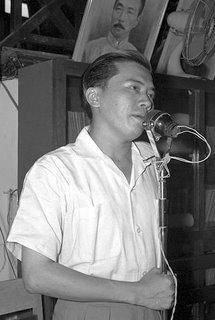
In April 1956, David Marshall led a 13 man all-party delegation to London for the scheduled constitutional talks. Lee Kuan Yew and Lim Chin Siong represented the PAP in the delegation. Despite the rhetoric of “Independence talks”, this underlying premise on the urgency to curb the left wing in Singapore, implicitly accepted as the programmatic consensus for the next phase of constitutional advance by all members of the delegation, except Lim Chin Siong. The talks eventually collapse when the British refused to compromise with the proposal of a Malayan chairman of the Defence and Security Council to oversee internal security. The British wanted control over the Internal Security. The talks collapse on this single issue.
Repression by Lim Yew Hock
The failure of the talks had major consequences on Singapore politics. David 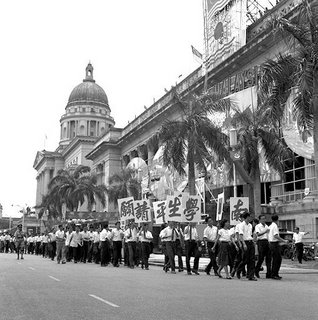 Marshall resigned and Lim Yew Hock took over, initiating a new wave of detention without trial to suspect left-wing activists. Meanwhile, 8 July 1956, Lim Chin Siong was elected to the Central Executive Committee (CEC) of the PAP with the largest number of votes, ahead of Lee Kuan Yew and Toh Chin Chye. But he was not on stage or at the photo taking as he was advised by LKY from it as he has a record of detention which might harm the Party. Months later, Lim Chin Siong and the rest have been made scapegoats for the later success independence talks with the British.
In October 1956, Lim Yew Hock ordered six persons to be arrested under banishment orders from the Chung Ching High School, with several unions being banned. The Special Branch detained Chia Ek Tian, a CEC member in PAP and Soon Loh Boon. At a  rally at Happy World Stadium to celebration the anniversary of the SFSWU, Chin Siong denounced the repression. But the repression escalated further when Minister of Education Chew Swee Kee issued orders to the management committees of the Chung Ching High School and Chinese High School to expel 142 students. When the students went on strike, the Government ordered the closure of schools. At the PAP rally held at Beauty World Park, Bukit Timah, Chin Siong condemned the repression and urged support for the besieged students. Singapore was in the state of riot. 13 people died and 123 injured. All the major Middle Road trade union leaders were detained, including Lim Chin Siong, Fong Swee Suan, Devan Nair, James Puthucheary, S. Woodhull and Chen Chiaw Thor.
*Read the rest of the article at http://singaporegovt.blogspot.sg/2006/07/history-of-pap-part-iv-lim-chin...